To kick things off I flew out to Munich, Germany 🇩🇪 for the annual WordPress.com division meetup—how about that timing! It was a little overwhelming to begin with, but ended up being the perfect way to start.
Working remotely makes it harder to get to know the folks you work with. So Munich was great opportunity for me to hang out with the WordPress.com design team and get to know the engineering teams I’ll be working with a bit.
After getting a glimpse of what’s planned for WordPress.com, I’m fired up and ready to get stuck in.
As a kid I loved to go out in rain storms. I found them calming. The sound of raindrops ripping through trees and bouncing off the ground. The feeling of hundreds of tiny traveller from the sky, existing for a few brief moments before being assimilated into its destination. The feeling of being soaked through and cold. So cold. That particular experience of cold that makes you yearn for the joy of warmth. Oh and the smell. The fresh scent of rain. Sitting in a treehouse cupping a hot mug of tea and watching the rain, I was transported back to those moments of my childhood.
In between jobs, we decided to book a few days away to help me switch off and found an amazing treehouse just outside Stockbridge, Hampshire. No WiFi. No TV. Perfect for escaping from the world for a while.
We arrived just as Storm Ciarán hit. Rain pelted the roof day and night. Anxieties about whether the track we’d taken to get here would be washed out were quickly replaced by a quiet optimism that perhaps fate would allow us to enjoy this break a little longer than we’d planned.
With no work and no internet, the pace of life slowed. My mind could breathe. All the stresses of the past year and a half melted away. I let go.
We passed time watching the rain and playing board games. I taught my daughter how to play checkers. Many rounds of Uno were dealt. Some kittens exploded.
Once the storm finally broke we enjoyed a day of calm blue skies. Roaming the countryside I was reminded how lucky I am to have experiences like this. To be able to share them with my family. So much of my time is spent within the world behind a computer screen, but life is lived beyond it.
Emitwise’s mission is to accelerate the transition to a Net Zero economy by helping enterprises with complex supply chains to decarbonise. I’m incredibly grateful to have played a part in their journey, for the people I’ve met, and for everything I learned along the way.
Now, I’m looking forward to a couple weeks off to recharge, do some woodworking, and perhaps take a couple motorcycle trips.
I stumbled across this documentary about Sebastian Cox and his mission to prove that sustainably sourced British woods can be used to create wonderful furniture.
Against The Grain – Documentary Film About Furniture Maker Sebastian Cox
Something that particularly resonated with me was how the craftspeople in his workshop are responsible for realising a product from start to finish. There’s no division of labour. Forcing people to develop their craft in a wide range of areas from preparing the wood and assembly, to final finish.
Sebastian refers to this principle of having people owning the whole process, as being derived from William Morris’ view of how mass production diminished craft skills during the Industrial Revolution.
It made me think about how fragmented a lot of product teams have become when building software. It’s rare to have a single persons that owns a whole feature. Things get divided up into design/engineering, frontend/backend, mobile/web. The division of labour is very present.
There are many good reasons for these divisions of course. But it’s a reflection of how the software industry is very much in the mass production phase of development.
I’ve often considered how the lack of ownership over the whole is reflected in the end quality of a feature or product. It’s possible to build great products this way, but I can’t help feeling that something is lost.
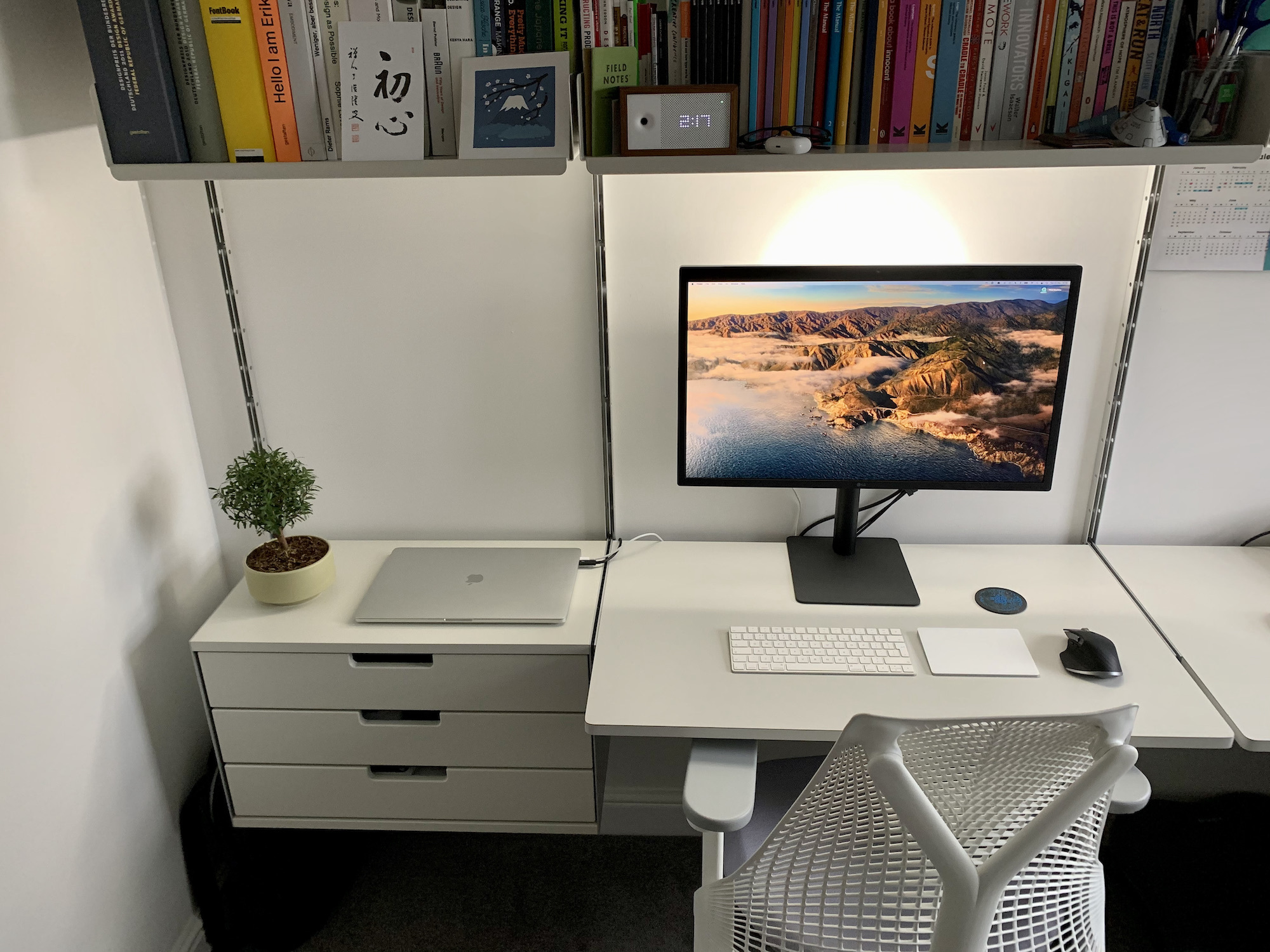
I broke out of my minimalist box this year and got a 27” monitor. I’ve always preferred to use my laptop screen when working. Less space forces me to focus and maintains a level of consistency regardless of where I’m working. I can’t deny that the 27” screen is useful though. Especially when working in Figma or Google Sheets.
My current workspace setup:
2019 MacBook Pro 16”
Apple Magic Keyboard
Apple Magic Touchpad
Logitech MX Master 3 for Mac
LG Ultrafine 27” Monitor
Vitsœ 606 Shelving System with Desk
Herman Miller Sayl Chair
Awair Air Monitor
Apple AirPods Pro
Hue Play Light Bar (Mounted behind the monitor)
Apple HomePod
Bonsai Tree 🌳
I also use an iPad Pro + Apple Pencil for early UI sketches and reading documentation. A well loved Baronfig Confidant serves as a secondary scratchpad to capture thoughts. There’s something satisfying about feeling a Rotring Rapid Pro glide effortlessly across paper that’s holding me back from going purely digital.
Climate change is real, it’s happening, and human activity is the driving force.
Last year I helped establish an Environment Committee at Wildbit. The group is tasked with monitoring and reducing the company’s environmental impact, focussing mainly on business travel, server infrastructure, and operations.
We recently published a report of Wildbit’s 2019 Greenhouse Gas Emissions along with some steps we’re taking to reduce our environmental impact. The report includes details on how we measured our emissions in the hope that it will help other companies to follow suit and measure their own environmental impact.
I urge you to read the report and start a committee in your own organisation. If I can help in any way, please reach out.
It’s not okay to stand aside and assume someone else will do the work. The clock is ticking and we’re running out of time. Act now.
I succeeded in maintaining my reading habit in 2018 and ended up reading 25 books. I keep a log of all the books I’ve finished on my website, but wanted to highlight a few of my favourites from 2018.
Professor Stephen Hawking has greatly inspired me over the years. In his final book—posthumously published—Hawking discusses his outlook on some of the biggest issues facing our existence.
If you’ve ever been interested in how OKRs can drive growth and ambition within an organisation, Measure What Mattersshould be at the top of your reading list. Written by the man that introduced OKRs to Google. John Doerr draws upon his wealth of experience working at Intel and other high-powered tech companies to demonstrate the power of OKRs in driving results where they matter.
Unbelievableis the story of how a young girl from Sheffield became an Olympic champion. I found this book as I was training for my first competitive races earlier this year and it provided buckets of inspiration to keep me going. It’s easy to overlook the amount of hard work required to rise to the top of your sport. Unbelievable gives you an inside look into the work and sacrifice that Jessica Ennis-Hill went through to get there.
I’ve long been fascinated with Pixar’s success and have read many books on the studio. Most of which have focussed on the creative/storytelling side of things but To Pixar and Beyondgives an insight into the business behind the hit movies. Lawrence Levy tells the story of his time as Pixar’s CFO, what it was like to work with Steve Jobs, and how he found meaning after leaving Pixar.
DHH and Jason Fried once again prompt us to slow down, take a step back, and reconsider how we are working. If you read Signal v. Noiseyou may have already encountered some of the ideas in this book, but it’s always good to have a refresher.
I’ve recently started using an app called TeuxDeux to help me plan my work for the week. It’s a brilliantly simple tool. The TeuxDeux website includes a /Purpose that outlines the team’s motivation for building the product and their vision for the future.
Simple enough to compete with a piece of paper.
Beautiful enough that we wouldn’t mind (and might even enjoy) looking at it all day.
The purpose of the app is perfectly captured in these two short sentences.
Build it simple. Build it beautiful.
The team’s vision for the future is equally inspiring:
If you like what you see with TeuxDeux (for example, its sparse, lovely design or intuitive personal timeline), you can take comfort in the fact that we will stay true to what it stands for today. Ten years from now”‰”””‰when we’ve finally domesticated koala bears and everyone can have one as a pet”‰”””‰TeuxDeux will still be chugging along, making your day-to-day just a little bit brighter. On that note, why the heck does every app need to change all the time? Can’t something on the Web be more or less finished? We think so.
The thing I love most about this vision is that there’s no mention of big feature developments, third-party integrations, or building a ‘platform’. The team behind TeuxDeux recognise that they’ve built a product that solves the problem they set out to tackle. They’ve resisted the urge to tinker.
It’s okay to call a product finished. You don’t have to be constantly changing things in order to grow your product.
By all means maintain your products, but don’t build more features just to create the illusion of progress in an attempt to attract more users. Build something useful and your customer base will grow with time.
We must be prepared to disagree more often. To challenge those philosophies which do not align with our modern views. To ensure we are not guided by dogma, and consider ideas in the context of our current beliefs and experiences.
To make progress we must understand the past. We must learn from our failures and our successes, but we must define our own future.
To blindly follow the thinking of those that came before is a decision to forego progress in pursuit of maintaining the ideals of the past.
Helen West (a.k.a. my Mum) has run a jewellery business for my entire life. She designs and makes individual pieces and sells them through her retail store. If you were to visit her workshop you’d find a wonderful array of tools and machines, but she didn’t decide to become a designer so that she could bend metal or hammer intricate patterns into a piece of silver all day. Helen’s a jeweller because she wants to express her creative ideas in the pieces she makes. Her satisfaction is not found in the swing of a hammer, but in the creation of an object that brings joy to it’s owner.
That said, Helen has a deep understanding of her tools. It’s a requirement in order to bring her ideas to life. She needs to know which set of pliers to use to bend the metal in just the right way, or which technique will allow her to create the finish she’s after.
I think the relationship between design and coding is very similar.
Code is merely the tool I use to bring my ideas to life. I don’t draw pleasure out of writing code all day. My satisfaction is found in designing and building something that’s more useful than that which came before it.
Not all designers want to bring their designs to life themselves. That’s okay. It doesn’t make them a “bad” designer, they just need to find someone they can trust to do that for them.
I’ve worked with some excellent designers that don’t code. I sometimes wonder if the absence of coding skills actually frees these designers to create more innovative products. Due to their limited knowledge about todays tools, they are not constrained by their limitations. They often create designs that force our tools to evolve. Of course, designers that code can do this too, it just take a little more conscious effort to break free of these constraints.
So should designers code?
Learning to code is a necessity if you want to bring your designs to life yourself. If you work with a great developer who you trust to respect your design decisions, it’s okay to delegate the coding to them.
Some jewellers design and make everything themselves, others hand off their designs to skilled craftspeople who bring those designs to life. Either approach is okay, it just depends on how you want to work.
Caveat: When I talk about coding in relation to the “should designers code?” question, I’m referring to interface design and frontend development (HTML, CSS, and JavaScript). Software engineering and backend development are specialised fields that I don’t think every designer needs to understand in depth.
Folks that are following along on Twitter might have noticed that I left No Divide a few weeks ago. Ryan and Dan were an absolute pleasure to work with, they’ve helped me grow both personally and professionally over the past 18 months and I’m extremely grateful for all their support.
Back in my freelancing days, I handled design and development for most of the projects I worked on. A lot of my clients were small businesses with small budgets so it just made sense for me to do everything. Despite this, I always considered myself more of a developer than a designer. When I took a job at No Divide where I would only be doing development work I didn’t think that I would miss the design stuff. I was wrong.
Over the past year I’ve come to realise that my true passion lies in design. I love the journey of conceiving a fragile idea and shaping it into a final product.
Much like a carpenter needs her tools to create a beautiful piece of furniture, development is simply the tool I need to create software. While a carpenter might get excited about a new hammer or chisel, it’s not what she lives for. I feel the same about code. I enjoy experimenting with new web technologies but it’s not what get’s me out of bed in the morning. I live to design things that help people.
It was time to switch my focus, but I knew this decision would bring an end to my time at No Divide.
I’m a bit picky when it comes to choosing a place to work. If I’m going to spend a significant amount of time working somewhere, I want to be sure that I’m surrounded by like-minded people who care about their work as much as I do.
Rather than trawling job boards I decided to make a list of companies who have values that align with mine. There were a few other requirements too, like the ability to work remotely and an openness to flexible working hours.
I ended up with a short list of just five companies. Three of them were hiring.
I wasn’t in a hurry to leave No Divide so I took my time with the applications and then patiently waited for any responses.
After interviewing with Wildbit I knew straight away that this was the company for me. It was clear that they truly live their values, and the role would allow me to switch my focus to design. After a couple of interviews and a small test project I got an offer. I accepted.
Last Monday I started at Wildbit as a designer on the marketing team. I’ll be focussing on raising awareness of Wildbit and their suite of products, Postmark, DeployBot and Beanstalk. I’m only a week in but things are going great so far. I’m hopefull that this is the start of an exciting new chapter.
Web forms are the evolution of their paper counterparts. A collection of labels, boxes and circles designed to constrain input and make it easier for data to be processed.
After all, a forms purpose is to collect data so an operation can be performed. To perform that operation the data we collect needs to be uniform. We place constraints on the interface to ensure this uniformity. Forms are designed to meet the needs of the process, not the user.
Forms often feel cold, inhuman. As a result, our responses are often cold and inhuman too. We leave out details. Things we might have mentioned if asked the same question by a friend, but this is a computer. All it wants is data. It doesn’t care. It’s like talking to someone that isn’t listening to you. Why bother when your words are not heard?
As with many digital things, forms have been heavily influenced by their analog predecessors. We have square boxes for writing in because that’s what we had on paper.
Paper, a form factor where the primary input method was a pen or pencil. Things have changed, yet we allow ourselves to be confined by the same constraints put in place hundreds of years ago.
Technology has freed us from these constraints. We’ve been given the tools to create more human interactions between people and computers.
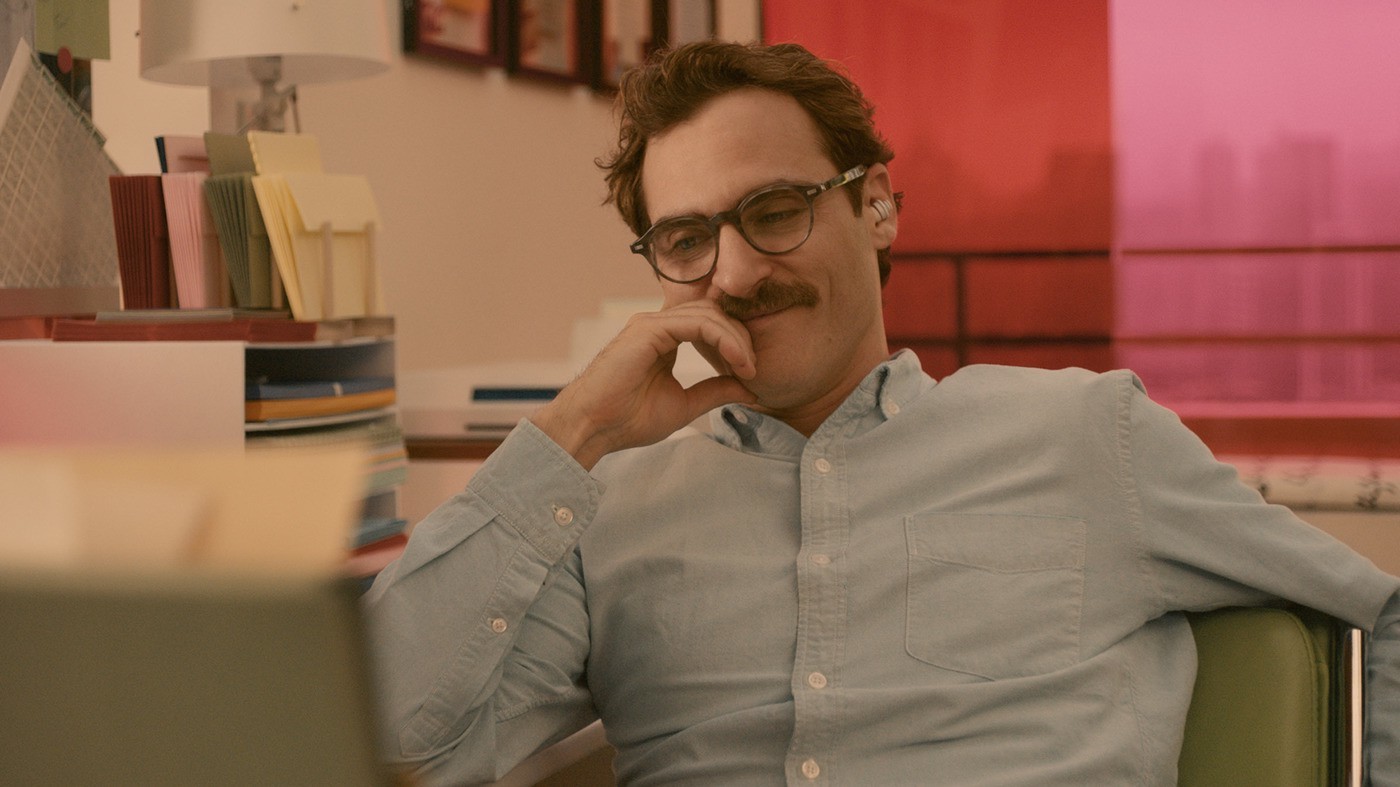
Spike Jonze’s film “Her” provides an interesting prediction for how we might interact with computers in the future.
We are rapidly approaching a time when speech recognition, natural language processing and artificial intelligence are at a level for humans to hold meaningful conversations with technology. Even now, our tools are good enough to start building some of these experiences.
So I bring you back to forms. How can we use these tools to make forms more human?
We need to break away from our preconceived notions of what defines a form interface. To focus on building a more natural experience and using technology to mask, not remove, the constraints needed to perform operations.
A conversation with Facebooks chat bot “Poncho”.
Over the past few years we’ve seen the introduction of a bunch of new products that aim to make our interactions with technology more natural. Siri, Alexa, chat bots, these are all moving us in the right direction but we’re yet to see these innovations bleed into the browser viewport in a significant way.
There’s so much potential for more conversational interfaces on the web and yet we still default to building forms out of a bunch of inputs and dropdowns when we need to collect data.
Some people are pushing forward with this. The insurance service Jack, recently launched with an impressive page for collecting the details needed to provide an insurance quote.
While the responses are still constrained, the design of the data collection process creates a much more enjoyable and friendly experience.
It would have been easier to just present the user with a standard web form, but by making the interaction with the user more like a conversation, Jack have managed to create something that feels far more natural.
Adrian Zumbrunnen’s conversations website azumbrunnen.me
Adrian Zumbrunnen captured the webs attention a while back when he released his conversational personal site. Adrian designed an interface that uses a selection of canned responses to guide the user on a tour of his work in the UI/UX field. Cleverly, Adrian’s website takes into account how the user reached his site and uses this as a signal to understand the user’s context.
We’re moving in the right direction but it still feels like something is missing. To build a truly conversational interface the technology needs to have an understanding of the user’s intention and context that goes beyond canned responses and cleverly positioned text fields. We need to build on the work done in the chat bot space and develop interfaces that people can interact with using natural language.
The interface should know who we are before we even start. The fundamental technology is already there for this. It’s called browser autofill. All of your details saved in one place, made accessible to a website with a simple request.
The interface should adapt itself based on the context of the situation. Did you start a conversation from the support page of a website or the homepage of the marketing site? These signals can help us to understand the user’s context and therefore tailor the systems responses appropriately. This is something that Adrian’s website does well.
Let’s experiment with how we might replace a sign up form with something more conversational.
What would the sign up flow look like if we moved beyond forms?
We have the data to do this today, but bringing it all together to create such a natural experience is really hard.
Consider the implications for accessibility, privacy, multi-language support, emotional and compassionate design. These are all challenges we need to overcome if we’re going to introduce a new era of more meaningful interactions with technology.
We’ve made incredibly progress so far but there’s still more work to be done. The future is just around the corner, but only if we’re brave enough to create it.
As humans we’re obsessed with the new. The must-have gadget that just hit the market. The latest style paraded down the fashion show catwalks.
Every time Apple releases a new iPhone there are queues a mile long of people wanting to get their hands on the latest package of glass, silicon and metal.
It is in our nature to want what is new and shiny.
In our personal lives this behaviour is harmful on our bank balance, but when it comes to building products it can do much more damage.
Subscribing to the latest design trend or adding the latest fashionable technology to your product only enters you into the perpetual cycle of having to re-invent your product every time something new comes along. You may gain some short-term wins but your product will quickly seem out-dated. You’re constantly running to catch up with the new trend.
Remember how QR codes got really popular a few years ago? Seeing one today makes me cringe.
When planning out your product roadmap forget what’s fashionable. Focus on the things that won’t change.
Amazon pours huge amounts of cash into building more distribution centres so that they can reduce the time it takes for an order to hit your doorstep. Nobody is ever going to wish that it took longer for their order to arrive.
Basecamp works hard to reduce the page load times for their project management software because nobody is ever going to think, “hmm, I wish this page took longer to load”.
Don’t look for excuses to use the latest trends in your product. They only have a place if they solve a genuine problem.
It’s okay not to be an early adopter.
Apple is famous for being late to the game with new technologies.
There were hundreds of MP3 players on the market before the iPod entered the mix.
Apple Pay launched years after NFC-enabled payments debuted in Android devices.
Smart watches date back to the 90s, long before the Apple Watch joined the fight for our wrist space.
Apple use what’s needed to build the product they want to build. They don’t cram some cool new technology into the latest iPhone just so the marketing department has something new to shout about. They’re not battling to match the feature lists of competitors.
Adding things that aren’t needed leads to a bloated product, and that will be a death sentence in the long run.
Great products are born from focus and simplicity.
Forget about fashion and concentrate on the things that matter.
Every once in a while an opportunity arises that will push you out of your comfort zone. That has the power to challenge your understanding of the world, and to inspire you to grow in ways you never thought possible.
Back in 2012 I was freelancing as a web designer and got involved in the early community of Treehouse students. Treehouse had setup a Facebook group where students could hang out and one day I logged on to find this post from Treehouse CEO Ryan Carson.
This post changed my life.
Until this point I had always hated writing. It was high on my list of activities to avoid at all costs. Somehow I forgot this as I fired off an email to register my interest in becoming an author.
I had an opportunity to take the knowledge and experience I had gained as a freelancer and help others get started in the web industry. I had to give this a shot.
Over the next few days I worked hard putting together a proposal for the book. I knew nothing about the publishing industry so searched online for any advice I could find about how to write a great proposal.
Later that week I got a call from Wiley. They loved my proposal. I got the job. I was set to be a published author and hadn’t even turned 20 yet.
After six months of intense writing, John Wiley & Sons published HTML5 Foundations in November 2012.
What started as a simple Facebook post had lead me on a journey that pushed me far beyond what I ever thought I was capable of.
It would have been so easy to just dismiss that post. To concede that there was someone much smarter and more qualified than me to write the book. To not even bother trying. But as Wayne Gretzky famously said: “You miss 100% of the shots you don’t take”.
Look out for opportunities that challenge you to break out of your comfort zone. You never know where they might lead you.