Blog

  • State of The Browser 2012

    Yesterday I got up early and headed down to London for State of The Browser 2012. The event was really great and I thought I would just summarise some of the thoughts from the main talks here.

    Web vs Native: it ain’t over ’til it’s over

    Michael Mahemoff (@mahemoff)

    Michael gave a great talk about how native apps still dominate their HTML5 counterparts. Despite the great work being done by some browser vendors to open up more native services to HTML5 apps (Chrome Canary now has a Battery API) web is still way behind native and that is limiting the scope of what web developers can achieve.

    The talk also focused on the challenges surrounding UI, offline and background processing that arise when building HTML5 apps. These issues need to be resolved quickly if HTML5 is going to be a real competitor to native apps.

    The slides can be found here: http://prez.mahemoff.com/state-native/#/

    No App is an Island

    Paul Kinlan (@paulkinlan)_

    Paul’s presentation ran with the theme that web apps should be able to talk to each other without the need for developers to write loads of code. This follows on from the work that Paul is doing on Web Intents.

    Android developers don’t have to worry about creating integrations to share content, they simply fire a share intent and the OS takes care of the rest. Browsers should be doing this and later on in the Q&A all of the other browser representatives admitted that they recognize this as a problem and are working on solutions.

    I personally follow Paul’s vision of an interconnected app ecosystem and really hope that Web Intents (or an equivalent) makes it’s way into browsers soon.

    The Web as it Should Be

    Martin Beeby (@thebeebs)

    Unfortunately Martin’s presentation was plagued with all sorts of technical problems but hats off to the guy as he still managed to power through. I was interested to see what Microsoft is doing in the web space so it was a shame the demos didn’t work.

    Martin spoke about Microsoft’s vision for the web and how they are pulling web technologies into the development environment of native app developers in Windows 8. This means that web developers will be able to use their existing skills in HTML, CSS and JS to create ‘native’ apps for Windows 8. The Microsoft engineers have created a JavaScript library for interacting with native APIs, which is awesome! I think Google are working on something similar for Android.

    Overall the fact that Microsoft seem to have stepped up their game within the web space is very encouraging. But sorry folks, still no plans for WebGL 🙁

    Broken HTML5 Promises – Are we ‘appy?

    Chris Heilmann (@codepo8)

    Chris’ talk focussed on were HTML5 is today and what we have got left to do in order to really give native apps a run for their money. He spoke about his experiences at the recent Mobile Web Congress in Barcelona and how many of the execs he spoke to were more concerned about getting short term wins than building meaningful apps.

    It’s sometimes easy to forget that there is still a lot of work to be done on HTML5 and a lot of this work is convincing decision makers in businesses that HTML5 is a viable option when it comes to building apps.

    Chris also mentioned the Boot to Gecko project were Mozilla are creating a phone OS that consists of a browser running directly on top of a Linux kernel (+ drivers of course). I hadn’t heard about this before but it looks really awesome, I can’t wait to get my hands on a demo device.

    Summary

    All round it was a rather good day out. I’m interested to see what will be happening with web technologies in Windows 8 going forward and how the web vs native battle will play out over the next year or so.

  • Hybrid People

    Society has always felt the need to categorize people, usually by a person’s occupation, social ”˜status’ (man I hate that crap) or their hobbies. We are no different in the web industry, we seem to have done a pretty good job of siloing people into specific roles.

    “Are you a designer or a developer?”

    This is a question that we all get asked on a fairly regular basis and we usually give a nervous either/or answer. But why? Surely we are capable of being both; we are; we are hybrids.

    Now sure not everyone is a hybrid but there are many of us out there that are equally skilled as both designers and developers.

    This is a topic that I have been thinking about for quite a while, the insecurities within me prodding at me to chose a single silo. It wasn’t until I watched Daniel Mall’s talk at NA Conf in January that I obtained the validation that I was subconsciously seeking in order to choose both. Dan also put a name to this group of multi-skilled wunderkind, ”˜Hybrid People’.

    I like the word ”˜hybrid’. It almost has a superhero vibe about it, like we should all wear capes and save unsuspecting visitors from bad design and broken contact forms.

    The common argument in support of siloing is that you should specialise because you “can’t be good at everything”. This is absolutely fantastically correct. We can’t know everything, but hybrids don’t know everything, we are just prepared to learn anything. Our lust for cross-domain superhero powers is what makes us hybrids and it’s what makes us different.

    Next time someone asks me if I’m a designer or developer I will answer “I’m a hybrid”. Truth be told we are all hybrids, some of us just don’t own the cape.

  • Sustaining vs Disruptive Innovation

    The difference between sustaining and disruptive innovation is commonly misunderstood by many in business. The main differentiation that I make is that sustaining innovation comes from listening to the needs of customers in the existing market and creating products that satisfy their predicted needs for the future. Disruptive innovation creates new markets separate to the mainstream; markets that are unknowable at the time of the technologies conception.

    Established market leaders are extremely good at dealing with and exploiting sustaining innovations in order to fuel the short-term growth of their companies. Disruptive innovations however, pose a challenge to market leaders that many fail to overcome. Why is this?

    Disruptive innovations create markets that are initially too small to ‘be interesting’ to large established firms. These firms have a responsibility to their shareholders to maintain continued growth rates which cannot be satisfied by the small initial returns obtained through pursuing emerging markets.

    The inability of large firms to enter these markets early gives smaller firms and start-ups the advantage of time. The dominant firms will, inevitably, enter these emerging markets when they become ‘interesting enough’, however the time between the markets conception and the entrance of these firms is a valuable resource for smaller firms that can use this period to build up knowledge of both the market and technology and establish a niche brand.

    “All predictions about markets that disruptive technologies will create have only one thing in common, they are all wrong.”

    It is impossible to accurately predict the markets created by disruptive technologies because they do not exist. This sounds obvious but so many companies pursue the identification of a single path for a disruptive technology. Only by doing this can they formulate an exact plan for their company when entering the market and justify investments of resources and capital. This pursuit is futile. Instead of trying to pursue an absolute path these companies should be preparing a plan that allows for multiple failures before identifying the true market for the technology. This iterative process has been well adopted by many internet companies over the past decade however companies in many other industries are still struggling with this concept.

    I am fascinated by disruptive innovation and the factors that determine whether a particular innovation will succeed or fail. Clayton Christensen’s book ‘The Innovators Dilemma’ explores these thoughts in depth. I would definitely recommend reading it (if you haven’t already).

  • Live every day as if it’s your first

    I just read this really awesome article on TechCrunch by James Altucher about how you can filter out negative thoughts so that you are more productive. The article is tailored towards entreprenuers with startups but I think that the ‘nine filters’ that James talks about are absolutely suited to life in general.

    “Live each day as if it is your first”

    One of my favourite bits of the article is the idea that you should live each day as if it is your first. When I read this I first thought about the Buddhist idea of having a beginner’s mind. The theory is that having a clear mind allows you to look at a situation with out any pre-conceptions and therefore produce an action that is truly your own. When you think about it this is pretty powerful.

    Being a web designer it’s easy to get bogged bown into the ‘standard’ layouts of a website and this can really put a downer on your creativity. If you asked someone to design a web page that had never seen one before I bet that it would look nothing like the sorts of web pages out there today. Having a mind free of any knowledge or pre-conceptions about a subject can help you to be really innovative, without even knowing it.

    Anyway you should check out the article it makes a really interesting read, you can find it here.

  • Onward by Howard Schultz

    I finished reading this earlier this week and thought that I would just write a few words about the book.

    This book is a very detailed account of Starbucks’ journey back to greatness. Howard Schultz takes you through the challenges that the company and he faced when trying to turn the company around and restore the culture.

    Overall I thought this book was pretty good and it made some thoroughly enjoyable reading. My favourite thing about the book was the fact that Howard had included the memos and emails sent out to Starbucks staff during the companies transformation. I would definitely recommend this book to anyone that is interested in business or Starbucks.

  • Latest Book Reviews

    I’ve recently completed my stereotypical geek persona by rediscovering my love for books. I used to read quite a lot when I was younger but I was always a really slow reader (Harry Potter and the Goblet of Fire took me two years – seriously) and this kind of put me off reading.

    The other day I decided to start reading a copy of ‘Wake up and change your life’ by Duncan Bannatyne (the business guy) which my dad had given me as a birthday present a few years back. It turns out it’s actually a pretty good book. Anyway for some reason I can now read at a decent speed so now reading is a lot more fun. I’ve managed to power my way through three books in the last week or so and I thought it would be a good idea to share with the readers of my blog (if there are any) some books that I think are really awesome. So in no particular order here goes.

    Delivering Happiness by Tony Hsieh

    This is a great book about how Tony built up Zappos.com around focusing on the company’s culture and the service that it provides it’s customers. While these may sound like obvious things for a business to focus on Tony’s “lets WOW our customers” approach is a step above anything that I have ever heard about before.

    Personally this has to be the best book that I have ever read. It has truly changed the way that I think about things and how I will run my company in the future.

    ReWork by Jason Fried & David Heinemeier Hansson

    This book looks at taking a totally different approach to the way that you work. Jason and David talk of how regularly working late nights and ‘workaholism’ are poison that will do more harm to your company (and you) in the long-run than the short-term benefits that these activities bring.

    This book questions so much of ‘traditional’ business ideals that I found a part of me reacting defensively to some of the claims that are made. However by making me question why I had that initial reaction I have come to see the benefits of this alternative way of running your business. If you’re in business or a self-confessed ‘workaholic’ then this is definitely worth a read.

    Googled: The End of the World As We Know It by Ken Auletta

    This book is all about how Google got to where they are today and offer’s a really interesting insight to the some of the goings on inside of Google. Ken takes you through the journey that Larry Page and Sergey Brin embarked upon when they decided to build a more useful search engine and the global business that subsequently followed.

    As a fan of all things Google I found this book a really interesting read. There is a lot of focus in the last few chapters on the “Google vs Traditional Media” battle which does have a few dry spots but overall it’s a great book. If you’re interested in Google then this book will provide you with some really good knowledge about how they got to were they are today.

    These are just a few of my favourite books. I’m reading Onwards by Howard Schultz (Starbucks) at the moment so I will post a mini review once I’ve finished it. Also ‘Delivering Happiness’ has changed the way I think about business (and business) so much that I plan to writing a post dedicated to some of the topics discussed in the book so keep an eye out for that one appearing on here soon.

    Thanks for reading!

  • Data Liberation for the masses

    Today you can find software to meet your every need from a task list app to keep track of what groceries you need to pick up to a business management system that is going to keep track of what your customers are purchasing and how much they are spending.

    Oh and there’s software that does even more amazing things like running the rockets (and the retired shuttle fleet) that put people up into space. Although this is probably going to be a little out of budget for average city dweller. Reuters once reported that the software designed for the space shuttle program cost $5000 dollars per line, yes PER LINE! Now think that that code base had around 500,000 lines initially.
    $5000 × 500,000 = One expensive project ($2,500,000,000)
    Anyway back to the topic…

    The problem with having all of these amazing systems that aim to make our lives that little bit easier is that you have your data in a large number of different places. This will always be an issue because certain applications will obviously need to store different data about you. However what happens when you want to move between services? The hard truth is that often it is a pain staking process of manually recreating a data profile item by item. This may be okay if you only have a few things to transfer but when you’re transferring years of invoices to a new invoicing system it’s painful (trust me, it will drive you to insanity). Wouldn’t it be easier if you could just get all of your data out of the old system with a simple click and then drop it into the new system. Well yes it would be, but who is interested in spending vital development time (and money) on helping people to leave their product.

    Many traditional businessmen might ask you to visit a shrink after proposing something as utterly ridiculous as making it easy for people to leave. However there is a lot of good that can come out of investing time in making sure that you provide a positive user experience right to the end, after all the easier it is to leave the more confident your users will be when putting their data in your hands.

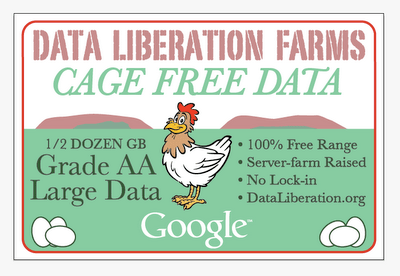
    Data Liberation


    © Google Inc.

    A pioneer of this open data movement is the Data Liberation Front, a team of Google engineers that strive to make it easier to move data in and out of Google products. Currently they have measures in place for 28 (that I know of) Google products and a website dedicated to providing information on how best to move your data. In true Google style once again this super-company’s engineers are right at the front of innovation. The data liberation front’s website outlines 3 main points that I think sum-up the data openness well:

    • You should be able to get out all of your data
    • It shouldn’t cost you any extra to get your data out
    • It should be as easy as possible

    By fulfilling all of these points you are well on your way to making sure that you are providing your users with the best possible experience. You might also find that they are more likely to use your products again in the future. I plan to build ‘data liberation’ tools into all of the software that I produce in the future, and might even revisit some old projects. My view is that it’s time wisely invested, what do you think?